I know. The Feelings Wheel looks like something you'd find on a therapist's wall next to a poster of a cat hanging from a branch. I get it. It's corny. It's a little cringey. And the first time a therapist pulls one out, most people want to leave the room.
But stay with me here, because this simple, slightly embarrassing circle is one of the most useful tools I use in session. Especially with men.
The problem with “fine”
Here's what I see constantly. A man comes into my office. I ask him how he's doing. He says “fine.” Or “good.” Or “stressed.” Or “bad.” That's it. That's the entire emotional vocabulary. Four words to describe the full range of human experience.
And it's not because he's shallow or emotionally stunted. It's because nobody taught him anything different. Most men grew up in environments where emotions were something you pushed through, not something you named. You learned to power through sadness, swallow frustration, and call anxiety “just stress.” Over time, the emotional vocabulary shrinks to almost nothing.
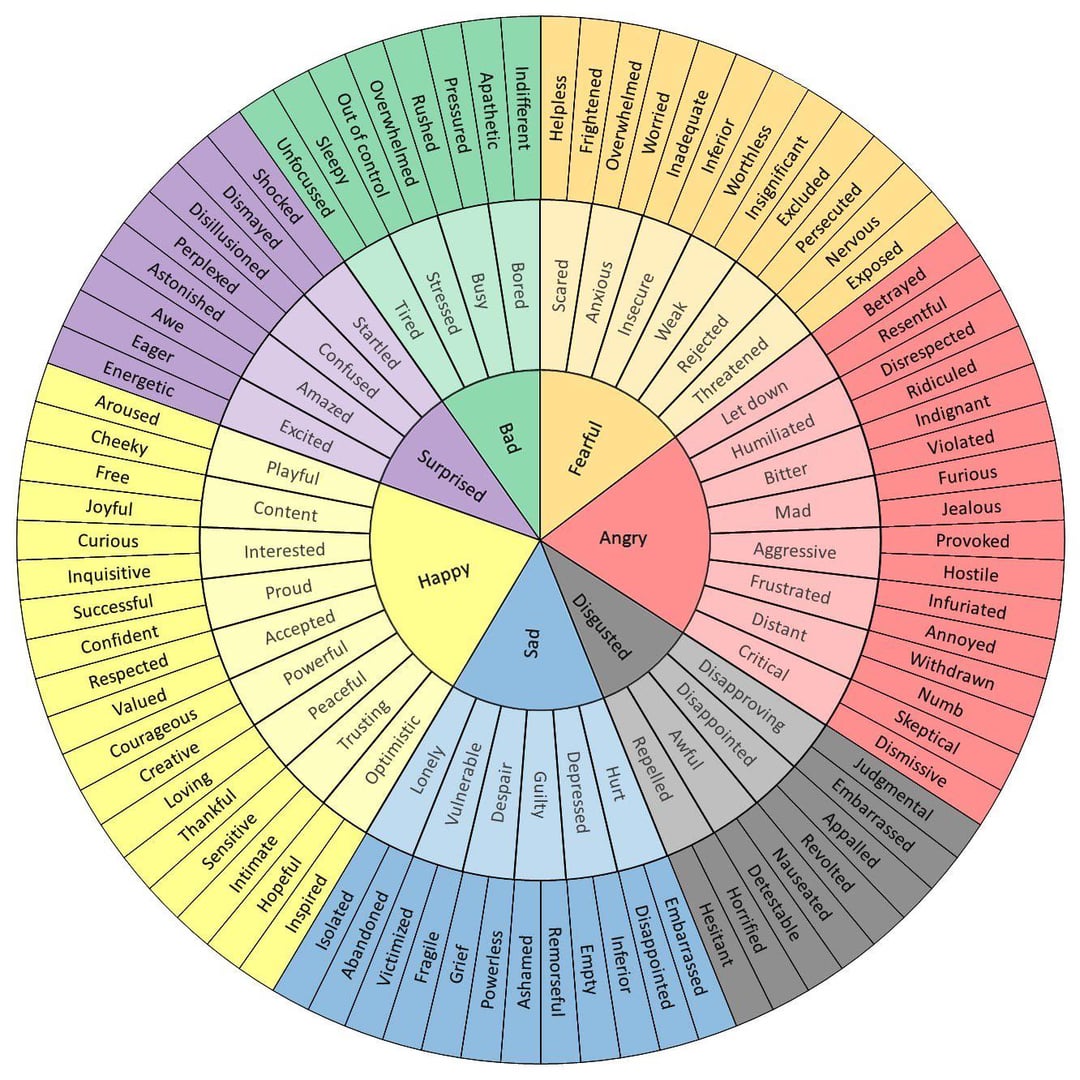
This is where the Feelings Wheel comes in. Created by Dr. Gloria Willcox, it's a simple diagram that starts with basic emotions in the centre and moves outward to more specific ones. “Sad” becomes “lonely,” “guilty,” “ashamed,” or “empty.” “Angry” becomes “frustrated,” “disrespected,” “bitter,” or “violated.” “Scared” becomes “insecure,” “overwhelmed,” “inadequate,” or “exposed.”
Suddenly you're not just “stressed.” You're overwhelmed. Or resentful. Or grieving. Those are very different experiences, and they need very different responses.
Why naming it matters
There's actual neuroscience behind this. Research on what psychologists call “affect labelling” shows that when you put a specific name to what you're feeling, it reduces the intensity of that emotion. The amygdala, the part of your brain that drives your fight or flight response, actually calms down when the prefrontal cortex gets involved through naming.
In plain language: when you can say “I'm feeling humiliated” instead of “I'm angry,” the emotion loses some of its power over you. You're no longer being pulled around by something you can't see. You've turned the light on, and now you can actually work with it.
This is not about being soft. It's about being precise. The same way a mechanic needs to know the difference between a loose belt and a cracked gasket, you need to know the difference between resentment and disappointment. Because the fix is completely different.
Why this is especially important for men
Most of the men I work with were never taught emotional vocabulary. Not at home. Not at school. Not in their friendships. The message, spoken or unspoken, was that emotions were a weakness. Something to manage, contain, or ignore.
So when emotions do show up, and they always do, they come out sideways. Irritability. Withdrawal. Overworking. Drinking. Scrolling. Picking fights over nothing. These aren't character flaws. They're what happens when you don't have the language for what's actually going on inside you.
The Feelings Wheel gives men a vocabulary they were never given. And once they have the words, something shifts. They start to notice patterns. They start to understand why they react the way they do. They start to communicate with their partners in ways that actually land.
How I use it in therapy
I don't pull out the Feelings Wheel in every session. But when a client is stuck on “I don't know what I'm feeling,” it becomes one of the most valuable tools in the room. I'll ask them to start in the centre of the wheel. Pick the broad emotion that feels closest. Then we move outward. We get more specific.
Sometimes a man comes in saying he's angry at his wife. But when we slow down and use the wheel, he realizes he's actually feeling rejected. Or unappreciated. Or scared that he's not enough. That's a completely different conversation. And it leads to completely different work.
The more precise you are about your emotions, the better the therapy. That's true whether you're working through relationship issues, processing grief, dealing with addiction recovery, or just trying to figure out why you feel stuck. Vague feelings lead to vague progress. Specific feelings lead to real breakthroughs.
You don't need to have it figured out
If the idea of naming your emotions feels awkward or uncomfortable, that's completely normal. Most men I work with feel that way in the beginning. You don't need to arrive at therapy with a perfect emotional vocabulary. That's part of what we build together.
You just need to be willing to try. To slow down for a second and ask yourself: what am I actually feeling right now? Not “fine.” Not “whatever.” What's really going on?
The Feelings Wheel might look corny. But it works. And sometimes the tools that feel the most uncomfortable are the ones that do the most good.
If you're ready to start doing this kind of work, a free 15-minute consultation is a good place to begin. No pressure. Just a conversation about what you're looking for.
Sources & Further Reading
- The Feeling Wheel: A Tool for Expanding Awareness of Emotions and Increasing Spontaneity and Intimacy. Dr. Gloria Willcox, Transactional Analysis Journal, 1982.
- Putting Feelings into Words: Affect Labeling Disrupts Amygdala Activity in Response to Affective Stimuli. Lieberman et al., Psychological Science, 2007.
- Emotional Granularity Increases with Intensive Emotion Regulation Training. Barrett et al., Psychological Science, 2001.
- Health Disparities in Boys and Men. American Psychological Association.

Joseph Addy
MDiv, RP (Qualifying), CSAT · Registered Psychotherapist (Qualifying) at Addy Psychotherapy in Etobicoke. Specializing in men's mental health, sex addiction recovery, and trauma.